Skip to content
alzh.ai

Atlas home Research tools

27 November 2026 · Toolkit 0.4.0

Open-data research results

Which trials tested clinical benefit?

Of 120 previously unscreened records, 30 met the design criteria. One met its primary endpoint, 19 missed, eight stopped with efficacy unresolved, one had different outcomes by treatment, and one had an unclear success rule.

Trials registered from 2014TrialsMetMechanism BrierBase-rate Brier
Published1440.22240.2106
Additional900.04300.0507
Combined2340.15220.1480

Lower Brier scores are better. All nine additional trials missed. Across the combined 23, the historical base rate had the lower error. One reviewer classified the trial outcomes. Only earlier publications entered training, and each tested drug was held out.

Download all 120 decisions Download 19 scored trials

120 records. Open a trial for its endpoints and sources.

NCT00010803 · Ginkgo Biloba Prevention Trial in Older Individuals (Outside core design)

Older adults with normal cognition or MCI were enrolled by age and the registry primary was incident dementia of any cause. Preserve as a general prevention comparison.

In the separately screened GEM general-population trial, Ginkgo biloba did not reduce all-cause dementia (HR 1.12, P=0.21) or AD (HR 1.16, P=0.11).

Registered primary outcomes · Number of Participants With Incident Dementia [Brief neuropsychological testing every 6 months, detailed testing annually, average 6.1 years follow up]

Arms · Placebo | Ginkgo biloba
Registry and results · Decision source

NCT00071721 · Valproate in Dementia (VALID) (Outside core design)

The valproate trial's primary hypothesis concerned emergence of agitation or psychosis.

Registered primary outcomes · Presence of Agitation and/or Psychosis Measured by the Neuropsychiatric Inventory (NPI) Combined With an Assessment of the Clinical Significance of Behavioral Change Rated by the Study Clinician [24 months]

Arms · 1 | 2

Registry and results

NCT00086138 · Depression in Alzheimer's Disease-2 (Outside core design)

The main clinical global rating concerned treatment of depression in AD.

Registered primary outcomes · Modfied Alzheimer's Disease Cooperative Study- Clinical Global Impression of Change (mADCS-CGIC) [Measured at Week 12]

Arms · 1 | 2

Registry and results

NCT00235716 · A Randomized, Clinical Trial of Vitamin E and Memantine in Alzheimer's Disease (Treatment-specific)

Illness-related daily functioning was a primary outcome in the factorial placebo-controlled vitamin E and memantine trial. Multiple active comparisons require separate interpretation.

Factorial TEAM-AD. Vitamin E slowed functional decline on ADCS-ADL versus placebo. Memantine and the combination did not meet their comparisons. A single trial label would erase these differences.

Registered primary outcomes · Alzheimer's Disease Cooperative Study/Activities of Daily Living (ADCS/ADL) Inventory Change From Baseline [6, 12, 18, 24, 30, 36, 42 and 48 months minus baseline] | Mini-Mental State Examination Change From Baseline [6, 12, 18, 24, 30, 36, 42 and 48 months minus baseline] | Alzheimer's Disease Assessment Scale - Cognitive (ADAS-cog) Change From Baseline [6, 12, 18, 24, 30, 36, 42 and 48 months minus baseline] | Neuropsychiatric Inventory Change From Baseline [6, 12, 18, 24, 30, 36, 42 and 48 months minus baseline] | Caregiver Activity Survey Change From Baseline [6, 12, 18, 24, 30, 36, 42 and 48 months minus baseline]

Arms · Arm 1 | Arm 2 | Arm 3 | Arm 4

Registry and results · Decision source

NCT00255086 · The Effect of Memantine on Brain Structure and Chemistry in Alzheimer's Disease Patients (Outside core design)

The primary endpoint was the magnetic resonance NAA/Cr ratio.

Registered primary outcomes · NAA/Cr Ratio [Baseline; Year 1]

Arms · Memantine | Control

Registry and results

NCT00348140 · Rosiglitazone (Extended Release Tablets) As Adjunctive Therapy In Subjects With Mild To Moderate Alzheimer's Disease (Missed)

The placebo-controlled adjunctive rosiglitazone study tested cognitive and global clinical outcomes under genotype-specific hypotheses.

The adjunctive phase 3 studies found no significant effect on the prespecified cognitive and global endpoints under their genotype testing strategy.

Registered primary outcomes · Change From Baseline in Alzheimer's Disease Assessment Scale - Cognitive Subscale (ADAS-Cog) Total Score at Week 48, as a Function of APOE ε4 Status in APOE4 Negatives Cohort [Baseline (Week 0) and Week 48] | Change From Baseline in ADAS-Cog Total Score at Week 48, as a Function of APOE ε4 Status in All Except E4/E4s Cohort [Baseline (Week 0) and Week 48] | Change From Baseline in ADAS-Cog Total Score at Week 48, as a Function of APOE ε4 Status in Full Population Cohort [Baseline (Week 0) and Week 48] | Change From Baseline in Clinical Dementia Rating Scale - Sum of Boxes (CDR-SB) Score at Week 48, as a Function of APOE ε4 Status in APOE4 Negatives Cohort [Baseline (Week 0) and Week 48] | Change From Baseline in CDR-SB Score at Week 48, as a Function of APOE ε4 Status in All Except E4/E4s Cohort [Baseline (Week 0) and Week 48] | Change From Baseline in CDR-SB Score at Week 48, as a Function of APOE ε4 Status in Full Population Cohort [Baseline (Week 0) and Week 48]

Arms · Arm 1 | Arm 2 | Arm 3

Registry and results · Decision source

NCT00409175 · Safety and Efficacy Study of Fx-1006A in Patients With Familial Amyloidosis (Outside core design)

The treatment population had familial amyloid polyneuropathy.

Registered primary outcomes · Percentage of Participants With Response to Treatment as Measured by Neuropathy Impairment Score - Lower Limb (NIS-LL) at Month 18 [Month 18] | Change From Baseline in Norfolk Quality of Life- Diabetic Neuropathy (QOL-DN) Total Quality of Life (TQOL) Score at Month 18 [Baseline, Month 18]

Arms · 1. | 2.

Registry and results

NCT00416078 · Online Caregiver Psychoeducation and Support for Alzheimer's (Outside core design)

Caregivers received a website or supportive calls.

Registered primary outcomes · Change in Caregiver Burden From Baseline [baseline to end-of-treatment (6 months)] | Change in Frequency of Patient Problematic Behavioral Patterns From Baseline [baseline to end of treatment (6 months)] | Change in Caregiver Negative Reactions to Problematic Behavioral Patterns From Baseline [baseline to end of treatment (6 months)] | Change in Caregiver Depression From Baseline [baseline to end-of-treatment (6 months)]

Arms · caregiver website support | caregiver brief supportive phone calls

Registry and results

NCT00428389 · Safety of Switching From Donepezil to Rivastigmine Patch in Patients With Probable Alzheimer's Disease (Outside core design)

Both study groups switched to rivastigmine on different schedules. Discontinuation was primary.

Registered primary outcomes · Number of Participants Who Discontinued From the Study Due to Any Reason During the Core Phase of the Study [Baseline through the end of the core phase of the study (Week 5)]

Arms · Immediate Switch | Delayed Switch

Registry and results

NCT00440050 · DHA (Docosahexaenoic Acid), an Omega 3 Fatty Acid, in Slowing the Progression of Alzheimer's Disease (Missed)

DHA was compared with placebo on longitudinal cognition and global progression.

DHA showed no benefit on either ADAS-Cog or CDR-SB over 18 months.

Registered primary outcomes · Rate of Change on the ADAS-Cog 11. [Baseline, 6, 12, 18 months] | Rate of Change on CDR-SOB [18 months]

Arms · 1. | 2.

Registry and results · Decision source

NCT00478205 · Comparison of 23 mg Donepezil Sustained Release (SR) to 10 mg Donepezil Immediate Release (IR) in Patients With Moderate to Severe Alzheimer's Disease (Outside core design)

Donepezil 23 mg was compared with the active 10 mg dose.

Registered primary outcomes · Change From Baseline to Week 24 in SIB Total Score [Baseline and Week 24] | Overall Change From Baseline in Modified CIBIC+ to Week 24 [Baseline and Week 24]

Arms · 1 | 2

Registry and results

NCT00490568 · Open-Label Extension Study Of Rosiglitazone XR As Adjunctive Therapy In Subjects With Mild-to-Moderate Alzheimers (Outside core design)

This open-label rosiglitazone extension had an adverse-event primary outcome.

Registered primary outcomes · Number of Participants With Any Adverse Events (AEs) and Severity of AEs [Up to 76 Weeks]

Arms · Rosiglitazone XR

Registry and results

NCT00506415 · Comparative Efficacy, Safety, and Tolerability of Rivastigmine 10 and 15 cm^2 Patch in Patients With Alzheimer's Disease (AD) Showing Cognitive Decline (Outside core design)

Both blinded treatment groups received active rivastigmine patch doses.

Registered primary outcomes · Change From Baseline in Alzheimer's Disease Assessment Scale-Cognitive (ADAS-Cog) Subscale at Week 48 of Double Blind Period [Baseline and week 48 of double blind period] | Change in Alzheimer's Disease Cooperative Study-Instrumental Activities of Daily Living (ADCS-IADL) Subscale Score From Baseline to Week 48 of Double Blind Period [Baseline and week 48 of double blind period]

Arms · Open label: Rivastigmine (5 cm^2 / 10 cm^2) | Double blind: Rivastigmine (10 cm^2) | Double blind: Rivastigmine (15 cm^2) | Extended open label Rivastigmine (10 cm^2)

Registry and results

NCT00539305 · Hormone and Information Processing Study (Indeterminate)

Randomized testosterone versus placebo included a primary verbal-learning outcome alongside mood and quality-of-life measures.

The small MCI study reported improvement on one verbal-memory measure within a battery. A study-wide prespecified success rule could not be established from the paper and registry.

Registered primary outcomes · Behavioral & Mood Measure: Profile of Mood States (POMS) [Baseline, 3 and 6 months] | Cognitive Changes Measured by Neuropsychological Tests: Rey Auditory Verbal Learning Test [Baseline, 3 and 6 months] | Geriatric Depression Scale (GDS) [Baseline, Month 3, Month 6] | Short-Form Health Survey (SF-36) [Baseline, Month 3, Month 6]

Arms · Study drug; testosterone transdermal gel | 2

Registry and results · Decision source

NCT00550420 · Study Of Rosiglitazone XR In Subjects With Mild-to-Moderate Alzheimers (Outside core design)

This single-arm rosiglitazone study counted adverse events.

Registered primary outcomes · Number of Participants With Any Adverse Events (AEs) and Severity of AEs [Up to Week 82]

Arms · Arm 1

Registry and results

NCT00566501 · Open-Label Extension Study of 23 mg Donepezil SR in Participants With Moderate to Severe Alzheimer's Disease (Outside core design)

The donepezil extension compared prior exposure groups for adverse events.

Registered primary outcomes · Number of Participants With Adverse Events (AEs) [From the enrollment of the study up to 30 days after last dose of the study drug (up to 2 years 3 months)]

Arms · Donepezil SR 23 mg (Donepezil SR 23 mg in Study NCT00478205) | Donepezil SR 23 mg (Donepezil IR 10 mg in Study NCT00478205)

Registry and results

NCT00679627 · A Study of Galantamine Used to Treat Patients With Mild to Moderate Alzheimer's Disease (Met)

Galantamine versus placebo included change in MMSE and mortality, requiring attention to each prespecified role.

The designated efficacy outcome, change in MMSE at month 24, favored galantamine (P<0.001). Mortality, the primary safety outcome, also favored treatment and prompted early stopping.

Registered primary outcomes · Change From Baseline in the Mini-Mental State Examination (MMSE) Score [Baseline, Month 24] | The Number of Deaths Reported in Participants [Up to 2 years]

Arms · Galantamine | Placebo

Registry and results · Decision source

NCT00762411 · Effects of LY450139, on the Progression of Alzheimer's Disease as Compared With Placebo (Missed)

The blinded semagacestat versus placebo trial registered cognitive and functional endpoints. Its decision must be distinguished from the sister trial.

The registry's own ADAS-Cog11 and ADCS-ADL comparisons of semagacestat with placebo missed (all P≥0.199). Treatment was stopped early. These comparisons belong to NCT00762411.

Registered primary outcomes · Change From Baseline in Alzheimer's Disease Assessment Scale- Cognitive Subscale (ADAS-Cog11) at 76 Weeks [Baseline (randomization), 76 weeks] | Change From Baseline in Alzheimer's Disease Assessment Scale- Cognitive Subscale (ADAS-Cog11) at 16 Weeks After Cessation of Study Drug [Baseline (randomization), 16 weeks following treatment cessation] | Change From Baseline in Alzheimer's Disease Cooperative Study Activities of Daily Living Inventory (ADCS-ADL) at 76 Weeks [Baseline (randomization), 76 weeks] | Change From Baseline in Alzheimer's Disease Cooperative Study Activities of Daily Living Inventory (ADCS-ADL) at 16 Weeks After Cessation of Study Drug [Baseline (randomization), 16 weeks following treatment cessation]

Arms · LY450139 | Placebo

Registry and results

NCT00791492 · An Extension of Study Fx-005 Evaluating Long-Term Safety And Clinical Outcomes Of Fx-1006A In Patients With Transthyretin Amyloid Polyneuropathy (Outside core design)

The open extension enrolled familial transthyretin amyloid polyneuropathy.

Registered primary outcomes · Percentage of Participants With Response to Treatment as Measured by Neuropathy Impairment Score - Lower Limb (NIS-LL) at Month 6 [Month 6] | Percentage of Participants With Response to Treatment as Measured by Neuropathy Impairment Score - Lower Limb (NIS-LL) at Month 12 [Month 12] | Change From Baseline in Norfolk Quality of Life- Diabetic Neuropathy (QOL-DN) Total Quality of Life (TQOL) Score at Month 6 [Baseline, Month 6] | Change From Baseline in Norfolk Quality of Life- Diabetic Neuropathy (QOL-DN) Total Quality of Life (TQOL) Score at Month 12 [Baseline, Month 12]

Arms · Fx-1006A

Registry and results

NCT00814801 · An Efficacy and Safety Study of Galantamine for the Treatment of Patients With Alzheimer's Disease (Missed)

The Japanese galantamine trial included placebo and cognition and global impression as clinical primary measures.

GAL-JPN-5. Both doses favored cognition on ADAS-J Cog. Neither met the other co-primary CIBIC plus-J, as documented in the Japanese regulatory submission, section 2.5.4.5.

Registered primary outcomes · Change From Baseline in the Alzheimer's Disease Assessment Scale - Japan Cognitive Subscale (ADAS-J Cog) [Baseline and 24 weeks] | Distribution of Clinician's Interview-Based Impression of Change Plus - Japan (CIBIC Plus-J) [24 weeks]

Arms · Placebo | Galantamine 16 mg/day | Galantamine 24 mg/day

Registry and results · Decision source

NCT00838110 · A Phase 3 Study To Evaluate The Safety And Tolerability Of Dimebon Patients With Mild To Moderate Alzheimer's Disease (Outside core design)

Both placebo-controlled dimebon cohorts primarily assessed safety, including abnormal vital signs.

Registered primary outcomes · Percentage of Participants With Abnormal Clinically Significant Vital Signs in Cohort 1 [Baseline up to Week 30 (follow-up)] | Percentage of Participants With Abnormal Clinically Significant Vital Signs in Cohort 2 [Baseline up to Week 16 (follow-up)] | Percentage of Participants With Abnormal Clinically Significant Electrocardiogram (ECG) Findings in Cohort 1 [Baseline up to Week 30 (follow-up)] | Percentage of Participants With Abnormal Clinically Significant Electrocardiogram (ECG) Findings in Cohort 2 [Baseline up to Week 16 (follow-up)] | Percentage of Participants With Abnormal Clinically Significant Laboratory Values in Cohort 1 [Baseline up to Week 30 (follow-up)] | Percentage of Participants With Abnormal Clinically Significant Laboratory Values in Cohort 2 [Baseline up to Week 16 (follow-up)] | Percentage of Participants With Adverse Events (AEs) in Cohort 1 [Baseline up to Week 30 (follow-up)] | Percentage of Participants With Adverse Events (AEs) in Cohort 2 [Baseline up to Week 16 (follow-up)]

Arms · Dimebon 20 mg TID (Cohort 1) | Placebo TID (Cohort 1) | Dimebon 20 mg TID (Cohort 2) | Placebo TID (Cohort 2)

Registry and results

NCT00857233 · Safety and Tolerability of Memantine in Moderate to Severe Alzheimer's Disease (Outside core design)

Single-arm memantine assessed adverse events and withdrawal for intolerance.

Registered primary outcomes · Number of Patients With Adverse Events (AEs) [Baseline to Week 24] | Percentage of Patients Who Withdrew Due to Intolerance to Treatment [Baseline to Week 24]

Arms · Memantine

Registry and results

NCT00857415 · Phase III Study of the Correlation Between Florbetapir F18 PET Imaging and Amyloid Pathology in the Brain (Outside core design)

This was an autopsy-validation study of amyloid PET diagnostic performance.

Registered primary outcomes · Correlation of Florbetapir-PET Image and Amyloid Plaque Density [at autopsy up to 12 months post-scan] | Specificity Analysis [50-60 min after injection]

Arms · Autopsy Cohort | Specificity Cohort

Registry and results

NCT00857649 · Efficacy and Safety of Memantine in Moderate to Severe Alzheimer's Disease (Missed)

The behaviorally enriched AD sample had cognition on the SIB as well as the NPI as co-primary outcomes.

The trial targeting patients with behavioral symptoms failed the cognitive SIB and neuropsychiatric NPI co-primary comparisons (P=0.603 and 0.418 respectively).

Registered primary outcomes · Efficacy of Memantine on Behavioural Symptoms in Outpatients With Moderate to Severe Dementia of the Alzheimer's Type Using the NPI - 12 Items Version Total Score. [Baseline to Week 24] | Efficacy of Memantine on Cognition in Outpatients With Moderate to Severe Dementia of the Alzheimer's Type Using the SIB Total Score. [Baseline to Week 24]

Arms · Memantine | Placebo

Registry and results · Decision source

NCT00898807 · Citalopram for Agitation in Alzheimer's Disease (Outside core design)

CitAD tested treatment of agitation, including an agitation-specific global rating.

Registered primary outcomes · NeuroBehavior Rating Scale-- Agitation [9 weeks] | Modified Alzheimer's Disease Cooperative Study- Clinical Global Impression of Change in Agitation(CGIC) [Baseline to 9 weeks]

Arms · Citalopram and psychosocial intervention | Placebo and psychosocial intervention

Registry and results

NCT00912288 · A Phase 3 Efficacy Study Of Dimebon In Patients With Moderate To Severe Alzheimer's Disease (Stopped, efficacy unresolved)

The moderate-to-severe AD efficacy trial registered SIB and ADL against placebo. Early termination requires a separate resolution.

Stopped after the separate CONNECTION readout. The registry reports zero participants analyzed on the two efficacy endpoints.

Registered primary outcomes · Change From Baseline in the Severe Impairment Battery (SIB) Score at Week 26 [Baseline, Week 26] | Change From Baseline in the Alzheimer's Disease Cooperative Study - Activities of Daily Living (Severe) (ADCS-ADLsev) Score at Week 26 [Baseline, Week 26]

Arms · Dimebon | Placebo

Registry and results

NCT00939783 · An Extension To The B1451027 Protocol To Evaluate The Long Term Safety And Tolerability Of Dimebon In Patients With Alzheimer's Disease (Outside core design)

This long-term open dimebon extension counted adverse events.

Registered primary outcomes · Percentage of Participants With Adverse Events (AEs) [Baseline up to Week 65 (end of treatment)]

Arms · Dimebon 20 mg TID

Registry and results

NCT00996918 · A Long-Term Safety And Tolerability Study Of Bapineuzumab In Alzheimer Disease Patients (Outside core design)

The bapineuzumab extension's primary measure was serious adverse events.

Registered primary outcomes · Number of Participants Reporting a Serious Adverse Event. [Up to Week 195]

Arms · Bapineuzumab 0.5 mg/kg | Bapineuzumab 1.0 m/kg

Registry and results

NCT00998764 · A Long-Term Safety And Tolerability Extension Study Of Bapineuzumab In Alzheimer Disease Patients (Outside core design)

The single-arm bapineuzumab extension counted serious adverse events.

Registered primary outcomes · Number of Participants Reporting a Serious Adverse Event [Up to Week 195]

Arms · Bapineuzumab 0.5 mg/kg

Registry and results

NCT01020838 · Phase III Study of Florbetaben (BAY94-9172) PET Imaging for Detection/Exclusion of Cerebral β-amyloid Compared to Histopathology (Outside core design)

The study measured florbetaben diagnostic performance against histology.

Registered primary outcomes · Sensitivity and Specificity of the Majority Read of Visual Assessment of Tracer Uptake Compared to Histological Verification of the Presence or Absence of Cerebral Beta-amyloid in Postmortem Specimens [90-110 minutes post injection (PET image acquisition)]

Arms · Florbetaben (BAY94-9172)

Registry and results

NCT01028053 · Assess the Prognostic Usefulness of Flutemetamol (18F) Injection for Identifying Subjects With Amnestic Mild Cognitive Impairment Who Will Convert to Clinically Probable Alzheimer's Disease (Outside core design)

The study tested prognosis by PET reader classification without a randomized therapeutic intervention.

Registered primary outcomes · Hazard Ratio (HR) by PET Scan Readers for Conversion to Probable Alzheimer's Disease Based on Visual Image Interpretation. [Up to 36 months post flutemetamol administration]

Arms · Flutemetamol (18F) Injection

Registry and results

NCT01035138 · A Study of Semagacestat for Alzheimer's Patients (Outside core design)

This was single-arm follow-up after semagacestat stopped.

Registered primary outcomes · Change From Baseline in Alzheimer's Disease Assessment Scale - Cognitive Subscale (ADAS-Cog11) at Week 16 After Cessation of Study Drug [Baseline (LFAN randomization), 16 weeks (LFBF) after cessation of study drug] | Change From Baseline in Alzheimer's Disease Cooperative Study Activities of Daily Living Inventory (ADCS-ADL) at Week 16 After Cessation of Study Drug [Baseline (LFAN randomization), 16 weeks (LFBF) after cessation of study drug]

Arms · Drug: semagacestat

Registry and results

NCT01053312 · PET Imaging of Brain Amyloid in Normal Pressure Hydrocephalus (Outside core design)

Flutemetamol uptake was compared with biopsy in normal-pressure hydrocephalus.

Registered primary outcomes · Quantitative Estimates of Brain Uptake [18F]Flutemetamol and the Quantitative Immunohistochemical (IHC) Estimates of Amyloid Levels in Biopsy Samples Previously Obtained. [Post-contrast administration] | Comparsion Between Brain Uptake of [18F] Flutemetamol Amyloid Level From Immunohistochemistry Assay and a Stained Biopsy Tissue Specimen. [Post-contrast administration]

Arms · 1 flutemetamol

Registry and results

NCT01066546 · An Extension To The B1451006 Protocol To Evaluate The Safety and Efficacy of Dimebon In Subjects With Moderate-to-Severe Alzheimer's Disease (Outside core design)

The dimebon extension counted adverse events without a placebo efficacy comparison.

Registered primary outcomes · Number of Participants With Adverse Events (AEs) [Baseline up to 4 weeks after last dose of study treatment]

Arms · Dimebon

Registry and results

NCT01092546 · Positron Emission Tomography Imaging of Brain Amyloid in Normal Pressure Hydrocephalus (Outside core design)

Tracer uptake was studied in normal-pressure hydrocephalus.

Registered primary outcomes · Standard Uptake Value Ratio (SUVR) at the Site of the Biopsy Based on the "Cerebellum" (CER) as the Reference Region. [Post flutemetamol Injection]

Arms · Arm 1

Registry and results

NCT01127633 · Continued Safety Monitoring of Solanezumab (LY2062430) in Alzheimer's Disease (Outside core design)

The continued solanezumab study primarily assessed drug-related and serious adverse events.

Registered primary outcomes · Assess the Number of Participants With One or More Drug-Related Adverse Events (AEs) or Any Serious AEs (SAEs) [Baseline through Week 104]

Arms · Solanezumab | Placebo

Registry and results

NCT01165554 · Positron Emission Tomography (PET) Imaging of Brain Amyloid Compared to Post-Mortem Levels (Outside core design)

The study validated flutemetamol PET against post-mortem pathology.

Registered primary outcomes · The Sensitivity of Blinded Visual Interpretations of [18F]Flutemetamol Positron Emission Tomography (PET) Images Without Anatomic Brain Images for Detecting Brain Fibrillar Amyloid β. [Post flutemetamol administration.]

Arms · [18F] Flutemetamol

Registry and results

NCT01172145 · Treatment of Apathy in Alzheimer's Disease With Modafinil (Outside core design)

Modafinil was tested for apathy on background cholinesterase inhibition.

Registered primary outcomes · Apathy [at baseline] | Apathy [after 8 weeks of treatment]

Arms · Cholinesterase inhibitor only | Cholinesterase Plus Modafinil

Registry and results

NCT01224106 · A Study of Gantenerumab in Participants With Prodromal Alzheimer's Disease (Missed)

The blinded SCarlet RoAD phase used CDR-SB at week 104. Extension safety is a separate outcome.

SCarlet RoAD stopped at its own prespecified futility analysis. Neither dose improved CDR-SB versus placebo.

Registered primary outcomes · Mean Change From Baseline in Clinical Dementia Rating Scale Sum of Boxes (CDR-SOB) Total Score at Week 104 (Double-Blind Treatment Phase) [Baseline, Week 104] | Number of Participants With Adverse Events (AEs) or Serious Adverse Events (SAEs) (OLE Phase) [Baseline up until a maximum of 5 years]

Arms · Placebo (Parts 1 and 2) | Gantenerumab 105 mg (Parts 1 and 2) | Gantenerumab 225 mg (Parts 1 and 2) | Placebo (Parts 1 and 2) switched to Gantenerumab Up to 1200mg (Part 3 Open-Label Extension [OLE]) | Gantenerumab Up to 1200 mg (Part 3 Open-Label Extension [OLE])

Registry and results · Decision source

NCT01265394 · Positron Emission Tomography (PET) Amyloid Imaging of the Brain in Healthy Young Adult Subjects (Outside core design)

The study characterized tracer scans in healthy young adults.

Registered primary outcomes · Number of Brain Scans in Healthy Young Adults Subjects Which do Not Show Amyloid [PET scans performed on patients 90 minutes post Flutemetmol Administration]

Arms · (18F) Flutemetamol

Registry and results

NCT01399125 · A 24-Week Efficacy, Safety and Tolerability of Rivastigmine Patch Study in Patients With Probable Alzheimer's Disease (Outside core design)

Rivastigmine patch was compared with active rivastigmine capsules.

Registered primary outcomes · Change From Baseline on Cognition, Assessed by the Alzheimer's Disease Assessment Scale-Cognitive (ADAS-Cog) [Change at 24 weeks]

Arms · Rivastigmine patch | Rivastigmine capsules

Registry and results

NCT01438060 · Aripiprazole in the Treatment of Patients With Psychosis Associated With Dementia of Alzheimer's Type (Outside core design)

Aripiprazole targeted dementia-associated psychosis.

Registered primary outcomes · Change From Baseline in Neuropsychiatric Inventory (NPI) Psychosis Subscale Score at Week 10 in Acute Phase [Baseline (Day 0), Week 10]

Arms · Aripiprazole (BMS-337039) | Placebo

Registry and results

NCT01447719 · Autopsy Follow-up of Subjects Previously Imaged With Florbetapir F 18 (18F-AV-45) PET in Trial 18F-AV-45-A07 (Outside core design)

The florbetapir autopsy study tested sensitivity and specificity.

Registered primary outcomes · Sensitivity Analysis in All Autopsy Population [at autopsy within 24 months of florbetapir PET scan] | Specificity Analysis in All Autopsy Population [at autopsy within 24 months of florbetapir PET scan] | Correlation of Florbetapir-PET Image and Amyloid Plaque Density [at autopsy within 24 months of florbetapir PET scan]

Arms ·

Registry and results

NCT01524887 · Phase 3 IGIV, 10% in Alzheimer´s Disease (Missed)

The IVIG trial planned two 18-month clinical primary endpoints. The registry distinguishes the external sister-trial stopping reason.

Terminated following the earlier sister trial. In this trial the required ADAS-Cog comparisons missed (P=0.243 and 0.370), precluding joint efficacy success.

Registered primary outcomes · Change From Baseline to Month 18 in Cognitive Subscale of the Alzheimer´s Disease Assessment Scale (ADAS-Cog) [Baseline to 9 Months (actual time frame)] | Change From Baseline to Month 18 in Alzheimer´s Disease Cooperative Study (ADCS)-Activities of Daily Living (ADL) Inventory [Baseline to 9 Months (actual time frame)]

Arms · IGIV, 10% at high dose (0.4 g/kg) | IGIV, 10% at low dose (0.2 g/kg) | Placebo control

Registry and results

NCT01561053 · A Study to Evaluate Albumin and Immunoglobulin in Alzheimer's Disease (Outside core design)

AMBAR compared plasma exchange plus replacement albumin, with or without immunoglobulin, against sham exchange. The drug effect cannot be isolated.

Registered primary outcomes · Alzheimer's Disease Assessment Scale - Cognitive Subscale (ADAS-Cog) Total Score (Changes From Baseline to 14 Months) [Baseline and 14 months] | Alzheimer's Disease Cooperative Study-Activities of Daily Living (ADCS-ADL) Total Score (Changes From Baseline to 14 Months) [Baseline and 14 Months]

Arms · High Albumin + Immunoglobulin | Low Albumin + Immunoglobulin | Low Albumin | Control (sham) group

Registry and results

NCT01565382 · Evaluation of Inter-reader Reliability Using Images From Subjects With Alzheimer's Disease (AD) or Mild Cognitive Impairment (MCI) (Outside core design)

The intervention trained image readers and measured inter-reader agreement.

Registered primary outcomes · Inter-reader Agreement - Median Kappa Statistic [50-60 min after injection]

Arms · Independent, blinded reader trainees

Registry and results

NCT01614886 · Randomized, Double-blind Study to Evaluate the Tolerability of 2 Different Titration Methods of Rivastigmine Patch in AD Patients (MMSE 10-20) (Outside core design)

Two rivastigmine titration methods were compared for discontinuation due to adverse events.

Registered primary outcomes · Percentage of Patients With Adverse Events Leading to Study Drug Discontinuation [Up to 24 weeks]

Arms · 1 step | 3 step

Registry and results

NCT01662882 · A Phase II Trial of Florbetapir (18F) Positron Emission Tomography (PET) Imaging in Japan of Healthy Volunteers, Patients With Mild Cognitive Impairment (MCI) and Patients With Alzheimer's Disease (AD) (Outside core design)

The florbetapir study compared image assessments across diagnostic groups.

Registered primary outcomes · Qualitative Amyloid Image Assessment [50-60 min after injection] | Mean Cortical to Cerebellum SUVR [50-60 min after injection]

Arms · AD Subjects | MCI | Healthy Controls

Registry and results

NCT01672827 · Effectiveness of an Electronic Training Program for Orienting and Interpreting [18F]Flutemetamol Positron Emission Tomography (PET) Images (Outside core design)

The flutemetamol study evaluated blinded PET sensitivity and specificity.

Registered primary outcomes · Summary of Sensitivity of the Blinded Visual PET Image Interpretations Without Anatomic Images. [Post flutemetamol administration] | Summary of Specificity of Blinded Visual PET Image Interpretations Without Anatomic Images. [Post flutemetamol administration]

Arms · [18F]Flutemetamol

Registry and results

NCT01736579 · Long-Term Study of IGIV, 10% in Alzheimer´s Disease (Outside core design)

The six-person IVIG study assessed adverse events and infusion safety.

Registered primary outcomes · Number and Severity of Treatment-emergent Adverse Events (AEs) and Serious Adverse Events (SAEs) [6 months] | Number of Infusions Temporally Associated With Adverse Events (AEs) and Serious Adverse Events (SAEs) [6 months] | Number of Infusions Causally Associated With Adverse Events (AEs) and Serious Adverse Events (SAEs) [6 months] | Number of Infusions Discontinued, Slowed or Interrupted Due to an Adverse Event (AE) or Serious Adverse Event (SAE) [6 months]

Arms · IGIV, 10% at 0.2 g/kg body weight | IGIV, 10% at 0.4 g/kg body weight

Registry and results

NCT01767909 · The Study of Nasal Insulin in the Fight Against Forgetfulness (SNIFF) (Missed)

Randomized intranasal insulin versus placebo measured ADAS-Cog12. Device cohorts require the primary publication's analysis set.

The prespecified primary analysis in the device-2 group found no ADAS-Cog12 benefit at month 12 (P=0.98).

Registered primary outcomes · Change in Global Measure of Cognition as Measured by the Alzheimer's Disease Assessment Scale-Cognitive 12 (ADAS-Cog12) [12 months (blinded phase) followed by 6 months (open label phase)]

Arms · Insulin (Humulin® R U-100) | Placebo

Registry and results · Decision source

NCT01862640 · A Phase 3, 12-week, Multicenter, Randomized, Double-blind, Placebo-controlled Trial to Evaluate the Efficacy, Safety, and Tolerability of 2 Fixed Doses of Brexpiprazole in the Treatment of Alzheimer's Agitation (Outside core design)

The brexpiprazole clinical outcome measured agitation on CMAI.

Registered primary outcomes · Change From Baseline In The Cohen-Mansfield Agitation Inventory (CMAI) Total Score After 12 Weeks Of Brexpiprazole Treatment [Baseline, Week 12/Early Termination (ET)]

Arms · Placebo | Brexpiprazole 1 mg | Brexpiprazole 2 mg

Registry and results

NCT01876823 · Memantine Plus Es-citalopram in Elderly Depressed Patients With Cognitive Impairment (Outside core design)

The escitalopram–memantine study had a single treatment group.

Registered primary outcomes · Change in Selective Reminding Test - Total Immediate Recall (SRT-IR) [baseline, 48 weeks]

Arms · es-citalopram and Memantine Treatment

Registry and results

NCT01922258 · Safety and Tolerability Study of Flexible Dosing of Brexpiprazole in the Treatment of Subjects With Agitation Associated With Dementia of the Alzheimer's Type (Outside core design)

The flexibly dosed brexpiprazole study measured agitation.

Registered primary outcomes · Change From Baseline to Week 12/Early Termination in the Cohen-Mansfield Agitation Inventory (CMAI) Total Score [From screening to week 12/early termination]

Arms · Placebo | Brexpiprazole (flexible dose range 0.5 to 2 mg)

Registry and results

NCT01931566 · Biomarker Qualification for Risk of Mild Cognitive Impairment (MCI) Due to Alzheimer's Disease (AD) and Safety and Efficacy Evaluation of Pioglitazone in Delaying Its Onset (Missed)

The TOMMORROW trial contained a randomized pioglitazone comparison for incident MCI due to AD, alongside a separate prognostic test.

TOMMORROW was stopped for futility. The low-dose pioglitazone versus placebo treatment comparison for onset of MCI due to AD missed (P=0.307).

Registered primary outcomes · Time to Diagnosis of Mild Cognitive Impairment Due to Alzheimer's Disease (MCI-AD) for Placebo-treated, High-risk, Non-Hispanic/Latino Caucasian Participants Versus Placebo-treated, Low-risk, Non-Hispanic/Latino Caucasian Participants [Baseline to the end of study (approximately up to 5 years)] | Time to Diagnosis of MCI Due to AD for Pioglitazone-treated, High-risk, Non-Hispanic/Latino Caucasian Participants Versus Placebo-treated, High-risk, Non-Hispanic/Latino, Caucasian Participants [Baseline to the end of study (approximately up to 5 years)]

Arms · Low Risk Placebo | High Risk Placebo | High Risk Pioglitazone

Registry and results · Decision source

NCT01994889 · Safety and Efficacy of Tafamidis in Patients With Transthyretin Cardiomyopathy (Outside core design)

The tafamidis trial targeted transthyretin cardiomyopathy.

Registered primary outcomes · Hierarchical Combination of All-Cause Mortality and Frequency of Cardiovascular-Related Hospitalizations [Baseline up to Month 30]

Arms · Tafamidis - 20 mg | Tafamidis - 80 mg | Placebo

Registry and results

NCT02016560 · Analysis of 18F-AV-1451 PET Imaging in Cognitively Healthy, MCI, and AD Subjects (Outside core design)

Imaging predicted subsequent cognitive decline without randomization to therapeutic treatment.

Registered primary outcomes · Confirmatory Phase: Relationship Between Neocortical Flortaucipir Uptake and the Subsequent Rate of Cognitive Decline [between baseline and 18 months] | Exploratory Phase: Cross-sectional Flortaucipir Imaging Results [baseline scan] | Exploratory Phase: Longitudinal Change in Tau Deposition Over Time, by Amyloid Status [baseline and 18 months]

Arms · Exploratory Cognitively Healthy Subjects | Exploratory MCI Subjects | Exploratory AD Subjects | Confirmatory Subjects

Registry and results

NCT02051608 · A Study of Gantenerumab in Participants With Mild Alzheimer Disease (Outside core design)

The posted amended primary measures concern open-label gantenerumab safety and immunogenicity. The original placebo-controlled period should not be counted as an efficacy result from these measures.

Registered primary outcomes · Part 2: Percentage of Participants With Adverse Events (AEs) or Serious Adverse Events (SAEs) [First dose up to 4 weeks after the last dose of study drug (up to 249 weeks)] | Part 2: Percentage of Participants With Treatment Emergent Anti-Drug Antibodies (ADAs) [First dose up to last dose (Baseline up to until maximum 5 years)] | Part 2: Percentage of Participants With Adverse Events Leading to Discontinuation of Treatment [First dose up to 4 weeks after the last dose in OLE (Up to approximately 249 weeks)]

Arms · Part 1 (Double Blind treatment): Placebo | Part 1 (Double Blind treatment): Gantenerumab | Part 2 (Open-Label Extension [OLE] treatment): Placebo switched to Gantenerumab Up to 1200 mg | Part 2 (OLE treatment): Gantenerumab up to 1200 mg

Registry and results

NCT02079246 · Long-term Safety and Tolerability of Idalopirdine (Lu AE58054) as Adjunctive Treatment to Donepezil in Patients With Mild-moderate Alzheimer's Disease (Outside core design)

The idalopirdine extension measured treatment-emergent adverse events.

Registered primary outcomes · Number of Treatment Emergent Adverse Events (TEAEs) in the OLEX [Baseline II (start of OLEX, week 0) to end of OLEX (week 28)] | Number of TEAEs in the OLEX-MEM [From Baseline III (start of OLEX-MEM, Week 28) to end of OLEX-MEM (Week 52)]

Arms · Idalopirdine (Lu AE58054) 60 mg | Idalopirdine 60 mg + memantine

Registry and results

NCT02080364 · Evaluation of the Efficacy and Safety of Azeliragon (TTP488) in Patients With Mild Alzheimer's Disease (Missed)

STEADFAST registered placebo-controlled azeliragon cognitive and global endpoints.

STEADFAST's sponsor reported lack of efficacy at 5 mg. The posted cognitive and global primary comparisons did not meet their thresholds.

Registered primary outcomes · Change From Baseline in Alzheimer's Disease Assessment Scale - Cognitive (ADAS-cog) Total Score [Baseline and 18 months (A-Study); baseline and 12 months (B-Study)] | Change From Baseline in Clinical Dementia Rating Scale Sum of Boxes (CDR-sb) [Baseline and 18 months (A-Study); baseline and 12 months (B-Study)]

Arms · Azeliragon 5mg | Placebo

Registry and results

NCT02245568 · Open-Label Study of Leuco-methylthioninium Bis(Hydromethanesulfonate) (LMTM) in Subjects With Alzheimer's Disease or Behavioral Variant Frontotemporal Dementia (bvFTD) (Outside core design)

The open LMTM extension primarily counted serious and other adverse events.

Registered primary outcomes · Number of Participants With Serious or Non-serious Adverse Events [Up to 34 months]

Arms · LMTM

Registry and results

NCT02248636 · Cholinesterase Inhibitor Discontinuation (Outside core design)

This withdrawal-management study assessed successful completion of discontinuation compared with sham discontinuation.

Registered primary outcomes · Successful Completion [6 weeks]

Arms · Real discontinuation | Sham discontinuation

Registry and results

NCT02284906 · AD-4833/TOMM40_303 Extension Study of the Safety and Efficacy of Pioglitazone to Slow Cognitive Decline in Participants With Mild Cognitive Impairment Due to Alzheimer Disease (Outside core design)

This non-randomized extension followed groups from the TOMMORROW trial.

Registered primary outcomes · Change From Extension Study Baseline in Composite Score of a Broad Cognitive Test Battery at Month 24 [Baseline and Month 24]

Arms · Pioglitazone 0.8 mg | Placebo

Registry and results

NCT02319005 · ENDEAVOUR: Phase 3 Multicenter Study of Revusiran (ALN-TTRSC) in Patients With Transthyretin (TTR) Mediated Familial Amyloidotic Cardiomyopathy (FAC) (Outside core design)

The study concerned transthyretin-mediated cardiomyopathy.

Registered primary outcomes · 6 Minute Walk Distance (6-MWD) [18 months] | Serum TTR Levels [18 months]

Arms · Revusiran (ALN-TTRSC) | Sterile Normal Saline (0.9% NaCl)

Registry and results

NCT02346201 · Apathy in Dementia Methylphenidate Trial 2 (Outside core design)

Methylphenidate was tested for AD-associated apathy.

Registered primary outcomes · Neuropsychiatric Inventory (NPI) [baseline to 6 months] | Percentage of Participants With Change in Modified Alzheimer's Disease Cooperative Study- Clinical Global Impression of Change (CGIC) [Baseline to month 6]

Arms · Methylphenidate | Placebo

Registry and results

NCT02350127 · Preventing Loss of Independence Through Exercise (PLIE) in Persons With Dementia (Outside core design)

PLIE compared immediate and delayed exercise programmes.

Registered primary outcomes · Quality of Life Scale in Alzheimer's Disease (QOL-AD) [4 months] | Short Physical Performance Battery (SPPB)-Modified [4 months] | Alzheimer's Disease Assessment Scale - Cognitive Subscale (ADAS-cog) [4 months]

Arms · Immediate Start | Delayed Start

Registry and results

NCT02442765 · Efficacy, Safety and Tolerability of AVP-786 for the Treatment of Agitation in Patients With Dementia of the Alzheimer's Type (Outside core design)

AVP-786 was tested for clinically significant agitation.

Registered primary outcomes · Stage 1 and Stage 2: Change From Baseline in the Cohen-Mansfield Agitation Inventory (CMAI) Composite Score to Week 6 and Week 12 [Stage 1: Baseline, Week 6; Stage 2: Baseline (Week 6), Week 12]

Arms · Stage 1: Placebo | Stage 1: AVP-786-18 (d6-DM 18 mg/Q 4.9 mg) | Stage 1: AVP-786-28 (d6-DM 28 mg/Q 4.9 mg) | Stage 2: Placebo | Stage 1: AVP-786-18 (d6-DM 18 mg/Q 4.9 mg) to: Stage 2: AVP-786-18 (d6-DM 18 mg/Q 4.9 mg) | Stage 1: AVP-786-28 (d6-DM 28 mg/Q 4.9 mg) to Stage 2: AVP-786-28 (d6-DM 28 mg/Q 4.9 mg) | Experimental: Stage 1: Placebo to: Stage 2: AVP-786-18 d6-DM 18 mg/Q 4.9 mg | Stage 1: Placebo to: Stage 2: AVP-786-28 d6 DM 28 mg/Q 4.9 mg

Registry and results

NCT02442778 · Efficacy, Safety, and Tolerability of AVP-786 for the Treatment of Agitation in Participants With Dementia of the Alzheimer's Type (Outside core design)

The AVP-786 primary outcome was the agitation inventory.

Registered primary outcomes · Change From Baseline to Week 12 in the Cohen-Mansfield Agitation Inventory (CMAI) Composite Score [Baseline, Week 12]

Arms · Placebo | AVP-786-28 | AVP-786-42.63

Registry and results

NCT02446132 · Long Term, Extension Study of the Safety and Efficacy of AVP-786 for the Treatment of Agitation in Patients With Dementia of the Alzheimer's Type (Outside core design)

The AVP-786 extension measured adverse events.

Registered primary outcomes · Number of Participants With Treatment-Emergent Adverse Events (TEAEs) [From first dose of study drug (in current study) up to 3 months after last dose of study drug (up to Week 64)] | Number of Participants With Serious TEAE [From first dose of study drug (in current study) up to 3 months after last dose of study drug (up to Week 64)] | Number of Participants With Potentially Clinically Significant Laboratory Test Abnormalities [Baseline (current study) up to 52 weeks] | Number of Participants With Potentially Clinically Significant 12-lead Electrocardiogram (ECG) Abnormalities [Baseline (current study) up to 52 weeks] | Number of Participants With Any Abnormal, Clinically Significant Physical and Neurological Examination Finding [Baseline (current study), Week 52] | Number of Participants With Potentially Clinically Significant Abnormalities in Vital Signs [Baseline (current study) up to 52 weeks] | Change From Baseline in the Sheehan Suicidality Tracking Scale (S-STS) Total Score at Week 64 [Baseline (current study), Week 64] | Change From Baseline in the Mini-Mental State Examination (MMSE) Score at Week 52 [Baseline (current study), Week 52] | Change From Baseline in the Epworth Sleepiness Scale (ESS) Score at Week 52 [Baseline (current study), Week 52]

Arms · AVP-786 18 milligrams (mg) | AVP-786 28 mg | AVP-786 42.63 mg

Registry and results

NCT02516046 · 18F-AV-1451 Autopsy Study (Outside core design)

The autopsy study assessed diagnostic performance of flortaucipir readers.

Registered primary outcomes · Primary Outcome 1: Diagnostic Performance of Individual Readers (NFT Score) [at autopsy within 9 months of baseline scan] | Primary Outcome 2: Diagnostic Performance of Individual Readers (NIA-AA Autopsy Diagnosis) [at autopsy within 9 months of baseline scan]

Arms · Flortaucipir PET Scan

Registry and results

NCT02565511 · A Study of CAD106 and CNP520 Versus Placebo in Participants at Risk for the Onset of Clinical Symptoms of Alzheimer's Disease (Stopped, efficacy unresolved)

Drug-specific placebo arms in Generation Study 1 planned incident MCI/dementia and the APCC. The CAD106 and umibecestat cohorts require separate interpretation.

Generation Study 1 ended prematurely. The truncated event and cognitive composite data do not resolve the intended confirmatory comparison across its two drug cohorts.

Registered primary outcomes · Time to Event (Diagnosis of Mild Cognitive Impairment or Dementia, Due to Alzheimer's Disease (AD)) [Baseline to end of exposure for a maximum of 1455 days for CI and 907 days for CII] | Change in the Alzheimer's Prevention Initiative Composite Cognitive (APCC) Test Score [CI = Baseline to Weeks 26, 52,78 104 and Baseline to last assessment; CII = Baseline to Weeks 26, 52, 78, 104 and Baseline to Last on-treatment and Baseline to Last off-treatment]

Arms · Cohort I (CAD106) | Cohort I (CAD106 Placebo) | Cohort II (CNP520) | Cohort II (CNP520 Placebo)

Registry and results

NCT02569398 · An Efficacy and Safety Study of Atabecestat in Participants Who Are Asymptomatic at Risk for Developing Alzheimer's Dementia (Stopped, efficacy unresolved)

The EARLY atabecestat study specified a placebo-controlled cognitive composite at month 24.

The EARLY study stopped for liver safety. The authors documented dose-related cognitive worsening during truncated follow-up. The planned month-24 benefit comparison is unresolved.

Registered primary outcomes · Change From Baseline in Preclinical Alzheimer Cognitive Composite (PACC) Score at Endpoint (Month 24) [Baseline and Endpoint (Month 24)]

Arms · Group 1 | Group 2 | Group 3

Registry and results · Decision source

NCT02586909 · 12-Month Open-Label Extension Study of Intepirdine (RVT-101) in Subjects With Alzheimer's Disease: MINDSET Extension (Outside core design)

The open intepirdine extension measured adverse events.

Registered primary outcomes · Occurrence of Adverse Events (AEs) and or Reported Changes in Physical Examinations, Vital Signs Measurements, Electrocardiograms (ECGs), Routine Laboratory Assessments [Baseline to 12 months or Early Termination]

Arms · RVT-101 35 mg tablets

Registry and results

NCT02670083 · A Study Evaluating the Efficacy and Safety of Crenezumab Versus Placebo in Participants With Prodromal to Mild Alzheimer's Disease (AD). (Missed)

CREAD tested crenezumab versus placebo on CDR-SB.

CREAD stopped after its own futility analysis. Its week-105 CDR-SB comparison missed (P=0.63).

Registered primary outcomes · Change From Baseline to Week 105 in Clinical Dementia Rating-Sum of Boxes (CDR-SB) Score [Baseline, Week 105]

Arms · Placebo | Crenezumab

Registry and results · Decision source

NCT02719327 · Brain Amyloid and Vascular Effects of Eicosapentaenoic Acid (Outside core design)

The randomized icosapent study used cerebral blood flow on MRI as primary.

Registered primary outcomes · Regional Cerebral Blood Flow Using Arterial Spin-labeling MRI [18 month study visit]

Arms · icosapent ethyl (IPE) | placebo

Registry and results

NCT02750306 · Safety and Efficacy of Suvorexant (MK-4305) for the Treatment of Insomnia in Participants With Alzheimer's Disease (MK-4305-061) (Outside core design)

Suvorexant treated insomnia and measured polysomnographic sleep time.

Registered primary outcomes · Change From Baseline in Polysomnography-derived Total Sleep Time (TST) at Week 4 [Baseline and Week 4] | Percentage of Participants Who Experienced One or More Adverse Events [Up to 6 weeks] | Percentage of Participants Who Discontinued Study Drug Due to an Adverse Event [Up to 4 weeks]

Arms · Suvorexant | Placebo

Registry and results

NCT02760602 · A Study of Solanezumab (LY2062430) in Participants With Prodromal Alzheimer's Disease (Stopped, efficacy unresolved)

The solanezumab prodromal-AD study planned a placebo-controlled ADAS-Cog14 comparison.

The prodromal study stopped after a programme decision. No participants were analyzed on the planned primary ADAS-Cog14 outcome.

Registered primary outcomes · Change From Baseline in Alzheimer´s Disease Assessment Scale- Cognitive Subscale (ADAS-Cog14) Score [Baseline, 24 Months]

Arms · Solanezumab | Placebo

Registry and results

NCT02791230 · Long-term Safety of Tafamidis in Subjects With Transthyretin Cardiomyopathy (Outside core design)

Tafamidis was tested in transthyretin cardiomyopathy.

Registered primary outcomes · Time to All-Cause Mortality: Cohort A [From first dose of randomized treatment in parent study (B3461028) up to 28 days post last dose of study treatment in current extension study (B3461045), [approximately up to 91 months]] | Number of Participants With All-Cause Mortality Events: Cohort B [B3461045: From first dose of treatment up to 28 days post last dose of study treatment (approximately up to 61 months)] | Number of Participants With Treatment-Emergent Adverse Events (AEs) [B3461045: From first dose of treatment up to 28 days post last dose of study treatment (approximately up to 61 months)]

Arms · Tafamidis

Registry and results

NCT02817906 · ITI-007 for the Treatment of Agitation in Patients With Dementia, Including Alzheimer's Disease (Outside core design)

ITI-007 was studied for agitation in dementia.

Registered primary outcomes · Change From Baseline in the Cohen-Mansfield Agitation Inventory - Community Version (CMAI-C) [4 weeks (28 Days)]

Arms · ITI-007 | Placebo

Registry and results

NCT02916056 · 2-Year Extension Study of Azeliragon in Subjects With Alzheimer's Disease (STEADFAST Extension) (Outside core design)

The azeliragon extension counted treatment-emergent adverse events.

Registered primary outcomes · Number of Subjects With at Least One Treatment-Emergent Adverse Event [up to 18 months]

Arms · Azeliragon 5 mg

Registry and results

NCT02956486 · A 24-Month Study to Evaluate the Efficacy and Safety of Elenbecestat (E2609) in Participants With Early Alzheimer's Disease (Missed)

The blinded elenbecestat core phase used CDR-SB versus placebo. Open-label extension safety is a separate phase.

The core CDR-SB comparison missed (P=0.385, 95% CI −0.57 to 0.22). The development programme stopped early.

Registered primary outcomes · Core Phase: Change From Baseline up to Month 24 in the Clinical Dementia Rating-sum of Boxes (CDR-SB) Score [Baseline (Day 1: before first dose in the core phase) up to Month 24 of the core phase] | Extension Phase: Number of Participants Reporting One or More Treatment-emergent Adverse Events (TEAEs) [From first dose of study drug up to approximately 6 months (including 1 month follow up) for the extension phase]

Arms · Core Study: Elenbecestat 50 mg | Core Study: Placebo | Open-label Extension Phase: Elenbecestat 50 mg

Registry and results

NCT02972658 · A Study of Lanabecestat (LY3314814) in Early Alzheimer's Disease Dementia (Outside core design)

In the extension, former placebo recipients switched to active lanabecestat. There was no concurrent blinded placebo arm in the extension.

Registered primary outcomes · Change From Baseline Analysis on the 13-item Alzheimer's Disease Assessment Scale - Cognitive Subscale (ADAS-Cog13) [AZES Baseline through AZFD Week 26]

Arms · AZES Lanabecestat 20 milligrams (mg)/AZFD Lanabecestat 20 mg | AZES Lanabecestat 50 mg/AZFD Lanabecestat 50 mg | AZES Placebo/AZFD Lanabecestat 20 mg | AZES Placebo/AZFD Lanabecestat 50 mg

Registry and results

NCT03114657 · A Study of Crenezumab Versus Placebo to Evaluate the Efficacy and Safety in Participants With Prodromal to Mild Alzheimer's Disease (AD) (Stopped, efficacy unresolved)

CREAD2 registered a separate blinded crenezumab comparison on CDR-SB.

CREAD2 stopped following the separate CREAD interim analysis. Its limited follow-up and abbreviated registry analysis do not establish the planned week-105 decision.

Registered primary outcomes · Change From Baseline to Week 77 in Clinical Dementia Rating-Sum of Boxes (CDR-SB) Scale Score [Baseline, Week 77]

Arms · Placebo | Crenezumab

Registry and results · Decision source

NCT03131453 · A Study of CNP520 Versus Placebo in Participants at Risk for the Onset of Clinical Symptoms of Alzheimer's Disease (Stopped, efficacy unresolved)

Generation Study 2 specified incident MCI/dementia and the APCC against placebo.

Generation Study 2 ended for safety. Shortened follow-up and descriptive event or cognitive data do not resolve the planned efficacy comparison.

Registered primary outcomes · Time to Event (Diagnosis of Mild Cognitive Impairment or Dementia, Due to Alzheimer's Disease (AD)) [Baseline to last cognitive assessment performed (up to day 648)] | Change in the Alzheimer's Prevention Initiative Composite Cognitive (APCC) Test Score [Baseline to Week 26, Baseline to Last on-treatment (Day 547) and Baseline to Last off-treatment (Day 648)]

Arms · CNP520 50 mg | CNP520 15 mg | Placebo

Registry and results

NCT03226522 · Addressing Dementia Via Agitation-Centered Evaluation (Outside core design)

The AXS-05 trial tested treatment of agitation on CMAI.

Registered primary outcomes · Change in CMAI Total Score [5 weeks]

Arms · AXS-05 | Bupropion | Placebo

Registry and results

NCT03325556 · Relapse Prevention Study of Pimavanserin in Dementia-related Psychosis (Outside core design)

HARMONY tested relapse of dementia-related psychosis across several dementia etiologies.

Registered primary outcomes · Time From Randomization to Relapse in the Double-blind (DB) Period [From randomization in the DB period through 26 weeks]

Arms · Placebo | Drug - Pimavanserin

Registry and results

NCT03446001 · Safety and Efficacy of TRx0237 in Subjects With Alzheimer's Disease Followed by Open-Label Treatment (Outside core design)

The LUCIDITY colour-matching control contained low-dose methylthioninium chloride, complicating interpretation against an inert placebo.

The comparator contained low-dose methylthioninium chloride for blinding, so the inert-placebo rule excludes LUCIDITY.

Registered primary outcomes · Change From Baseline on Alzheimer's Disease Assessment Scale - Cognitive Subscale (ADAS-cog11) (16 mg/Day vs Control) [52 weeks] | Change From Baseline on Alzheimer's Disease Cooperative Study - Activities of Daily Living (ADCS-ADL23) (16 mg/Day vs Control) [52 weeks] | Number of Study Participants With Serious and Non-serious Adverse Events (16 mg/Day vs Control) [52 weeks]

Arms · TRx0237 16 mg/day | Control | TRx0237 8 mg/day

Registry and results

NCT03451591 · LACunar Intervention (LACI-2) Trial-2 (Outside core design)

LACI-2 was a lacunar-stroke feasibility trial.

Registered primary outcomes · Feasibility of Phase III Trial [36 months (24 Months Recruitment + 12 months Follow Up)]

Arms · Isosorbide Mononitrate XL (ISMN) | Cilostazol | ISMN XL and Cilostazol | Neither ISMN nor cilostazol

Registry and results

NCT03486938 · Study of AGB101 in Mild Cognitive Impairment Due to Alzheimer's Disease (Missed)

HOPE4MCI tested AGB101 versus placebo on CDR-SB.

HOPE4MCI. The prespecified CDR-SB estimate for AGB101 versus placebo was −0.10 (95% CI −0.85 to 0.58).

Registered primary outcomes · Change in Clinical Dementia Rating Scale - Sum of Boxes (CDR-SB) Score From Baseline [78 weeks]

Arms · Placebo Oral Tablet | AGB101 220 mg tablet

Registry and results · Decision source

NCT03491150 · An Open-Label Crenezumab Study in Participants With Alzheimer's Disease (Outside core design)

The open crenezumab follow-up counted adverse events and anti-drug antibodies.

Registered primary outcomes · Percentage of Participants With Adverse Events (AEs) and Serious Adverse Events (SAEs) [Baseline up to 16 weeks after the last dose of study drug (up to 54 weeks).] | Percentage of Participants With Anti-Crenezumab Antibodies [Baseline up to end of study (up to 54 weeks).]

Arms · Parent Placebo | Parent Crenezumab

Registry and results

NCT03548584 · A Trial to Evaluate the Safety, Efficacy, and Tolerability of Brexpiprazole in Treating Agitation Associated With Dementia of the Alzheimer's Type (Outside core design)

Brexpiprazole was tested for agitation on CMAI.

Registered primary outcomes · Change From Baseline to Week 12 in the CMAI Total Score [Baseline and Week 12]

Arms · Brexpiprazole 2 mg | Brexpiprazole 3 mg | Placebo

Registry and results

NCT03594123 · A 12-week Extension Trial to Evaluate the Safety and Tolerability of Brexpiprazole in the Treatment of Subjects With Agitation Associated With Dementia of the Alzheimer's Type (Outside core design)

The brexpiprazole extension counted treatment-emergent adverse events.

Registered primary outcomes · Percentage of Participants With Treatment-emergent Adverse Events (TEAEs) by Severity [From first dose through 30 days after last dose of study drug (Up to approximately Week 16)]

Arms · Prior Brexpiprazole | Prior Placebo

Registry and results

NCT03620981 · Brexpiprazole for the Treatment of Patients With Agitation Associated With Dementia of the Alzheimer's Type (Outside core design)

The Japanese brexpiprazole study tested agitation on CMAI.

Registered primary outcomes · Change From Baseline in Cohen-Manfield Agitation Inventory(CMAI) Score at 10 Weeks After Dosing. [Baseline and 10 weeks first dose, on average 10 weeks]

Arms · Brexpiprazole, 1mg/day | Brexpiprazole, 2mg/day | Placebo

Registry and results

NCT03682185 · The Healthy Patterns Sleep Study (Outside core design)

Healthy Patterns evaluated a timed activity intervention.

Registered primary outcomes · Change in the Quality of Life in Alzheimer's Disease (QOL-AD) Scale [Baseline and 1 month]

Arms · Timed Activity Intervention Protocol | Attention-Control Condition

Registry and results

NCT03721705 · Renew NCP-5 for the Treatment of Mild Cognitive Impairment Due to Alzheimer's Disease (AD) or Mild Dementia of the Alzheimer's Type (Outside core design)

Renew NCP-5 compared external counterpulsation with a sham device.

Registered primary outcomes · Mean Change From Baseline to 24 Weeks in Vascular Dementia Assessment Scale Cognitive Subscale (vADAS-cog) Using the Average of Scores at 12, 18 and 24 Weeks. [24 weeks]

Arms · Treatment Arm | Sham Arm

Registry and results

NCT03724942 · Brexpiprazole for the Long-term Treatment of Patients With Agitation Associated With Dementia of the Alzheimer's Type (Outside core design)

The brexpiprazole long-term study counted treatment-emergent adverse events.

Registered primary outcomes · The Frequency of Subjects With Treatment-Emergent Adverse Events (TEAEs) [From baseline to week 14]

Arms · Brexpiprazole

Registry and results

NCT03823404 · GAIN Trial: Phase 2/3 Study of COR388 in Subjects With Alzheimer's Disease (Missed)

GAIN tested atuzaginstat versus placebo on ADAS-Cog and ADCS-ADL.

The sponsor reported both GAIN co-primary endpoints missed in the overall population. A reported subgroup result cannot determine the full-trial outcome.

Registered primary outcomes · Alzheimer's Disease Assessment Scale-Cognitive Subscale 11 (ADAS-Cog 11) [Baseline to Week 48] | Alzheimer's Disease Cooperative Study Group-Activities of Daily Living (ADCS-ADL) [Baseline to Week 48]

Arms · COR388 80 mg twice daily (BID) | COR388 40 mg BID | Placebo BID

Registry and results · Decision source

NCT03860935 · Efficacy and Safety of AG10 in Subjects With Transthyretin Amyloid Cardiomyopathy (Outside core design)

The acoramidis study targeted transthyretin amyloid cardiomyopathy.

Registered primary outcomes · A Hierarchical Combination of All-Cause Mortality, Cumulative Frequency of CV-related Hospitalization, Change From Baseline in NT-proBNP and Change From Baseline in 6MWT at the Last Available Visit Where Both Subjects Had Non-missing Assessments. [Baseline up to Month 30]

Arms · acoramidis HCl 800 mg | Placebo

Registry and results

NCT03901092 · A Reader Study to Assess Accuracy and Reliability of Flortaucipir F 18 Positron Emission Tomography (PET) Scan Interpretation (Outside core design)

The flortaucipir reader study assessed diagnostic accuracy at autopsy.

Registered primary outcomes · Primary Objective 1 Analysis 1: Diagnostic Performance of Individual Readers (NFT Score) [baseline scan] | Primary Objective 1 Analysis 2: Diagnostic Performance of Individual Readers (NIA-AA Autopsy Diagnosis) [baseline scan] | Primary Objective 2: Inter-reader Reliability of Reader Interpretation of Flortaucipir-PET Imaging [baseline scan]

Arms · Flortaucipir PET Scan

Registry and results

NCT03901105 · Evaluation of Flortaucipir PET Signal and Cognitive Change in Early Alzheimer's Disease (Outside core design)

The study tested prognostic PET signal, without a randomized therapeutic comparison.

Registered primary outcomes · Risk Ratio for AD Symptom Progression on CDR-SB [Within 18 months of scan]

Arms · Flortaucipir PET Scan

Registry and results

NCT04241068 · A Study to Evaluate Safety and Tolerability of Aducanumab in Participants With Alzheimer's Disease Who Had Previously Participated in the Aducanumab Studies 221AD103, 221AD301, 221AD302 and 221AD205 (Outside core design)

Aducanumab re-exposure assessed safety.

Registered primary outcomes · Core Treatment Period: Number of Participants With Treatment-Emergent Adverse Events (TEAEs) and Serious TEAEs [From the first dose of study drug to end of follow-up (up to Week 118)] | Core Treatment Period: Number of Participants With AEs Leading to Treatment Discontinuation (TD) and Study Withdrawal (SW) [From the first dose of study drug to end of follow-up (up to Week 118)] | Core Treatment Period: Number of Participants With Amyloid-Related Imaging Abnormality-Edema (ARIA-E) [Up to Week 118] | Core Treatment Period: Number of Participants With Amyloid-Related Imaging Abnormality- Hemorrhage or Superficial Siderosis (ARIA-H) [Up to Week 118] | Core Treatment Period: Number of Participants With Positive Antidrug Antibodies (ADAs) in Serum [Up to Week 102]

Arms · Aducanumab

Registry and results

NCT04339413 · A Study to Evaluate the Safety and Tolerability of Long-term Administration of Gantenerumab in Participants With Alzheimer's Disease (AD) (Outside core design)

The post-gantenerumab follow-up assessed adverse events and suicidality.

Registered primary outcomes · Number of Participants With Adverse Events (AEs) and Serious Adverse Events (SAEs) [Baseline [Day 1] up to 4 weeks after the last dose of study drug (Up to Week 133)] | Number of Participants With Change in Any Suicidal Ideation or Behavior as Assessed by Columbia-Suicide Severity Rating Scale (C-SSRS) [Baseline (Day 1), up to Week 104] | Number of Participants With Amyloid-Related Imaging Abnormalities-Edema (ARIA-E) AEs [Baseline [Day 1] up to 4 weeks after the last dose of study drug (Up to Week 133)] | Number of Participants With Amyloid-Related Imaging Abnormalities-Haemosiderin Deposition (ARIA-H) AEs [Baseline [Day 1] up to 4 weeks after the last dose of study drug (Up to Week 133)] | Number of Participants With Anti-drug Antibody (ADA) to Gantenerumab [Up to Week 133] | Number of Participants With Injection-Site Reactions [Baseline [Day 1] up to 4 weeks after the last dose of study drug (Up to Week 133)] | Number of Participants Who Discontinued Treatment Due to AEs [Baseline [Day 1] up to 4 weeks after the last dose of study drug (Up to Week 133)]

Arms · SCarlet RoAD | Marguerite RoAD

Registry and results

NCT04374253 · A Study to Evaluate the Safety, Tolerability, and Efficacy of Long-Term Gantenerumab Administration in Participants With Alzheimer's Disease (AD) (Outside core design)

The gantenerumab rollover assessed long-term safety.

Registered primary outcomes · Number of Participants With at Least One Adverse Event (AE) and Serious Adverse Event (SAE) [From Baseline (OLE Day 1) up to 14 weeks after the last dose (up to 134 weeks)] | Number of Participants With Post-baseline Suicidal Ideation or Suicidal Behavior as Measured Using Columbia-Suicide Severity Rating Scale (C-SSRS) Score [From Baseline (OLE Day 1) up to 14 weeks after the last dose (up to 134 weeks)] | Number of Participants With at Least One Amyloid-Related Imaging Abnormalities-Edema (ARIA-E) Confirmed by MRI [From Baseline (OLE Day 1) up to 14 weeks after the last dose (up to 134 weeks)] | Number of Participants With at Least One Amyloid-Related Imaging Abnormalities-Haemosiderin Deposition (ARIA-H) Confirmed by MRI [From Baseline (OLE Day 1) up to 14 weeks after the last dose (up to 134 weeks)] | Number of Participants With Injection-Site Reactions (ISRs) [From Baseline (OLE Day 1) up to 14 weeks after the last dose (up to 134 weeks)] | Number of Participants Who Discontinued the Study Due an AE [From Baseline (OLE Day 1) up to 14 weeks after the last dose (up to 134 weeks)] | Number of Participants With at Least One Adverse Event of Special Interest (AESI) [From Baseline (OLE Day 1) up to 14 weeks after the last dose (up to 134 weeks)]

Arms · Group 1 | Group 2

Registry and results

NCT04408755 · Assessment of the Efficacy, Safety, and Tolerability of AVP-786 for the Treatment of Agitation in Patients With Dementia of the Alzheimer's Type (Outside core design)

AVP-786 was tested for agitation on CMAI.

Registered primary outcomes · Change From the End of Period A (Week 1) to Week 10 in the Cohen-Mansfield Agitation Inventory (CMAI) Composite Score [Week 1 to Week 10] | Number of Participants With Treatment Emergent Adverse Events (TEAE) and Serious TEAE [From randomization (Week 2) up to 30 days after last dose of study drug (Up to Week 16)]

Arms · Placebo | AVP-786-18 | AVP-786-42.63

Registry and results

NCT04464564 · Study to Assess the Efficacy, Safety, and Tolerability of AVP-786 for the Treatment of Agitation in Patients With Dementia of the Alzheimer's Type (Outside core design)

AVP-786 was tested for agitation on CMAI.

Registered primary outcomes · Change From the End of Period A (Week 1) to Week 10 in the Cohen-Mansfield Agitation Inventory (CMAI) Composite Score [Week 1 to Week 10] | Number of Participants With Treatment Emergent Adverse Events (TEAE) and Serious TEAE [From randomization (Week 2) up to 30 days after last dose of study drug (Up to Week 16)]

Arms · Placebo | AVP-786-18 | AVP-786-42.63

Registry and results

NCT04488419 · ATH-1017 for Treatment of Mild to Moderate Alzheimer's Disease (Missed)

LIFT-AD tested fosgonimeton versus placebo on a global statistical test combining clinical measures.

LIFT-AD's primary global statistical test in the prespecified population without acetylcholinesterase inhibitors missed (P=0.70).

Registered primary outcomes · Global Statistical Test (GST) Score [Baseline and Week 26]

Arms · Dosage | Placebo

Registry and results · Decision source

NCT04623242 · Dominantly Inherited Alzheimer Network Trial: An Opportunity to Prevent Dementia. A Study of Potential Disease Modifying Treatments in Individuals at Risk for or With a Type of Early Onset Alzheimer's Disease Caused by a Genetic Mutation. (Missed)

The DIAN-TU platform tested two drugs against matching placebo on a cognitive endpoint. Verify the original parent registration before retrospective prediction.

Neither antibody slowed cognitive decline in DIAN-TU. The trial tests two agents and this registry record was transferred from the earlier parent trial NCT01760005.

Registered primary outcomes · Assess Cognitive Efficacy in Individuals With Mutations Causing Dominantly Inherited AD as Measured by the DIAN-Multivariate Cognitive Endpoint (DIAN-MCE); [Baseline through Week 260]

Arms · Gantenerumab | Solanezumab | Matching placebo (Gantenerumab) | Matching Placebo (Solanezumab)

Registry and results · Decision source

NCT04770220 · An Efficacy and Safety Study of ALZ-801 in APOE4/4 Early AD Subjects (Missed)

APOLLOE4 tested valiltramiprosate against placebo on ADAS-Cog13 in early AD.

APOLLOE4's full cohort missed ADAS-Cog13 (P=0.6058). The MCI subgroup result answers a different question.

Registered primary outcomes · Primary Cognitive Efficacy Endpoint (ADAS-Cog13) [Baseline to Week 78] | Incidence, Nature, and Severity of Treatment Emergent Adverse Events (TEAE) [Entire study: approximately 82 weeks. (first dose of study drug until end of Safety Follow-up Visit at 28 +/- 7 days after the last dose (ie, 78-week treatment period plus 4-weeks follow-up after last dose up to total of 82 weeks)]

Arms · ALZ-801 | Placebo

Registry and results · Decision source

NCT04886063 · Open Label Study of ATH-1017 for Treatment of Mild to Moderate Alzheimer's Disease (Outside core design)

The open fosgonimeton extension counted treatment-emergent adverse events.

Registered primary outcomes · Incidence of Treatment-Emergent Adverse Events [Safety and Tolerability] [Up to 173 weeks (study termination)]

Arms · Treatment

Registry and results

NCT05108922 · A Study of Donanemab (LY3002813) Compared With Aducanumab in Participants With Early Symptomatic Alzheimer's Disease (TRAILBLAZER-ALZ 4) (Outside core design)

Donanemab and aducanumab were compared on PET amyloid plaque clearance.

Registered primary outcomes · Percentage of Participants Who Reach Complete Amyloid Plaque Clearance on Florbetapir F18 Positron Emission Tomography (PET) Scan (Superiority) on Donanemab Versus Aducanumab [6 Months] | Percentage of Participants Who Reach Complete Amyloid Plaque Clearance on Florbetapir F18 PET Scan in the Low/Medium (Intermediate) Subpopulation (Superiority) on Donanemab Versus Aducanumab [6 Months]

Arms · Donanemab | Aducanumab

Registry and results

NCT05256134 · A Study to Evaluate the Efficacy and Safety of Gantenerumab in Participants at Risk for or at the Earliest Stages of Alzheimer's Disease (AD) (Stopped, efficacy unresolved)

SKYLINE planned a blinded gantenerumab-versus-placebo PACC-5 comparison.

SKYLINE ended after a different early-AD programme readout. The small exposed groups and early termination do not resolve the planned PACC-5 comparison.

Registered primary outcomes · Change From Baseline in PACC-5 Score [Baseline to early termination visit (up to 225 days from start of treatment)]

Arms · Gantenerumab | Placebo

Registry and results

NCT05267535 · Piromelatine 20 mg in Participants With Mild Dementia Due to Alzheimer's Disease (Missed)

Piromelatine was compared with placebo on ADAS-Cog14.

The sponsor's registry termination statement explicitly reports no efficacy for 20 mg versus placebo on the primary ADAS-Cog14.

Registered primary outcomes · Alzheimer's Disease Assessment Scale Cognitive Subscale (ADAS-cog 14) [26 weeks]

Arms · Piromelatine 20 mg | Placebo

Registry and results

NCT05310071 · A Study to Verify the Clinical Benefit of Aducanumab in Participants With Early Alzheimer's Disease (Stopped, efficacy unresolved)

ENVISION specified a blinded aducanumab CDR-SB comparison. Determine whether efficacy was evaluated before discontinuation.

ENVISION stopped after a sponsor decision. Only 6 and 8 participants contributed week-78 CDR-SB scores, without an evaluable confirmatory comparison.

Registered primary outcomes · Change From Baseline in Clinical Dementia Rating Scale - Sum of Boxes (CDR-SB) Score at Week 78 [Baseline, Week 78]

Arms · Aducanumab | Placebo

Registry and results

NCT05557409 · A Study to Assess the Efficacy and Safety of AXS-05 in Subjects With Alzheimer's Disease Agitation (Outside core design)

This AXS-05 study tested agitation on CMAI.

Registered primary outcomes · Cohen-Mansfield Agitation Inventory (CMAI) [Up to 5 weeks]

Arms · AXS-05 | Placebo

Registry and results

NCT05575076 · Open-label Extension for Phase 3 Clinical Trials of Simufilam (Outside core design)

The open simufilam extension assessed adverse events.

Registered primary outcomes · Number of Participants With Adverse Events [Baseline to 52 weeks]

Arms · Simufilam 100 mg

Registry and results

NCT05686044 · A Dose-ranging Study to Investigate Efficacy of Buntanetap in Mild to Moderate AD (Missed)

Buntanetap was compared with placebo on ADAS-Cog11 and ADCS-CGIC.

The intention-to-treat comparisons missed both ADAS-Cog11 and ADCS-CGIC at week 12. The reported signal in a biomarker-defined subgroup was exploratory.

Registered primary outcomes · Change From Baseline to Week 12 in ADAS-Cog11 [Baseline to the end of treatment period (12 weeks)] | ADCS-CGIC at Week 12 [Baseline to the end of treatment period (12 weeks)]

Arms · 7.5mg Buntanetap/Posiphen | 15mg Buntanetap/Posiphen | 30mg Buntanetap/Posiphen | Placebo

Registry and results · Decision source

NCT05738486 · A Study of Different Donanemab (LY3002813) Dosing Regimens in Adults With Early Alzheimer's Disease (TRAILBLAZER-ALZ 6) (Outside core design)

Donanemab dosing schedules were compared on occurrence of ARIA-E.

Registered primary outcomes · Percentage of Participants With Any Occurrence of Amyloid-Related Imaging Abnormality-Edema/Effusion (ARIA-E) [24 Weeks]

Arms · 1400 mg Donanemab - Standard Regimen | 1400 mg Donanemab - Dose Skipping | 1400 mg Donanemab - Titration | 1400 mg Donanemab - Maximum Concentration (Cmax) | Donanemab Addendum 2 Arm 1 | Donanemab Addendum 2 Arm 2

Registry and results

NCT05891496 · A Research Study Looking at the Effect of Semaglutide on the Immune System and Other Biological Processes in People With Alzheimer's Disease (Outside core design)

The semaglutide crossover studied molecular changes in CSF cells.

Registered primary outcomes · Change in Gene Expression Assessed by Single-cell Ribonucleic Acid Sequencing (scRNAseq) (Cells in Cerebrospinal Fluid [CSF]) [Baseline (week 0), week 12] | Change in Gene Expression Assessed by scRNAseq (Cells in Blood) [Baseline (week 0), week 12]

Arms · Study intervention period 1 | Study intervention period 2

Registry and results

NCT06424236 · Dominantly Inherited Alzheimer Network Trial: An Opportunity to Prevent Dementia: A Study of Potential Disease Modifying Treatments in Individuals at Risk for or With a Type of Early Onset Alzheimer's Disease Caused by a Genetic Mutation (Outside core design)

The single-arm gantenerumab extension primarily measured amyloid PET change.

Registered primary outcomes · Change From Baseline in Composite [11C] Pittsburgh Compound B (PiB)-Positron Emission Tomography (PET) Composite Standardized Uptake Value Ratio (C-SUVR) at Weeks 52, 104 and 156 [Baseline (Day 1) and Weeks 52, 104 and 156]

Arms · Gantenerumab Open Label Extension

Registry and results

NCT06736509 · An Open-Label Study to Assess the Long-term Safety of AXS-05 in Subjects With Dementia of the Alzheimer's Type, ADVANCE-2 and ACCORD-2 Extension Study (Outside core design)

The open AXS-05 extension assessed long-term safety.

Registered primary outcomes · Long-Term Safety [Up to 25 weeks]

Arms · Open-Label

Registry and results

GSE48552 donor data

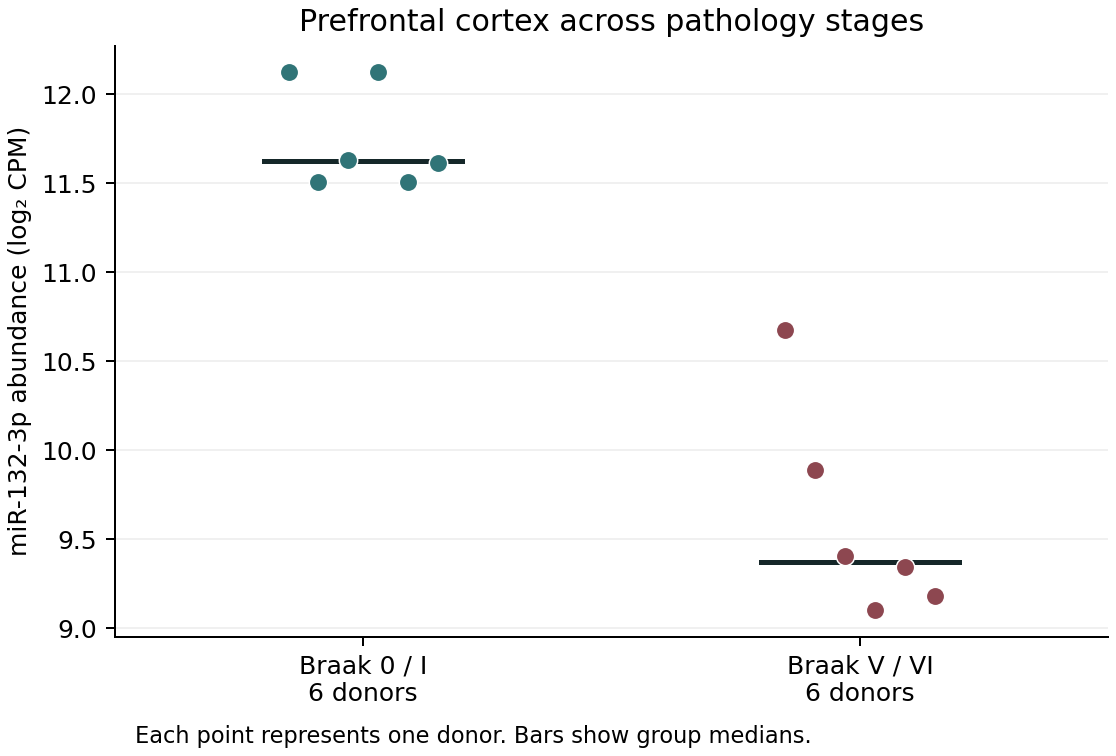
All six Braak V/VI donors had lower expression than all six Braak 0/I donors. The median difference was -2.25 log₂ CPM (exact P=0.00216, adjusted q=0.01394). The GSE48552 recount covered 165,932,186 reads and reproduced a result previously reported in these donors.

Download 12 donor measurements (TSV)Open GEO study

Preview donor data
GEO sampleBraak stagemiR-132-3p readslog₂ CPM
GSM118071705,86712.12
GSM118071802,36911.51
GSM118071904,50611.63
GSM118072004,69612.12
GSM118072112,66411.51
GSM118072213,14211.61
GSM118072356,71410.67
GSM118072462,9859.89
GSM118072561,9619.40
GSM118072662,6619.10
GSM118072762,1889.34
GSM118072862,0599.18
Six donors in each stage group. All six late-stage miR-132-3p values are below the six early-stage values.

An independent counter matched all 41,812 target reads. Normalizing to all archive reads gave −1.59 log₂ CPM. Age and sex adjustment gave an estimated mean difference of −2.10 (95% interval −3.13 to −1.06).

Download all 573 miRNAs

Does the MS4A signal recur across cohorts?

The rs1582763 A allele was associated with higher CSF sTREM2 in Wang’s 250-person non-European ancestry group (β +0.357, 95% CI +0.163 to +0.550, P=0.000373). Within the target region, 436 variants have an estimate in that group. The authors selected those variants using European significance. Wang and the original discovery study shared recruitment networks. Public records do not resolve individual overlap across papers.

At a second marker, rs7232, the 377-person Chinese CABLE validation reported P=0.0106. Wang’s non-European group gave P=0.795 at that marker. The full region still lacks an independently assessable CSF shared-signal estimate.

Download 488 selected variants Download the source audit CABLE paper Wang paper

Reproduce the results

The release contains the trial decisions, donor counts, selected variants and the code to replay all three analyses. The evidence packet also opens offline.

Get the code and evidence packet Methods and commands